








Colombia Official Travel Guide
![]()
![]()
You are here:
The Sierra Nevada de Santa Marta is a magical destination where the wisdom of nature and the indigenous people are joined. Every step taken into its depth is an encounter with truly unique beauty and exuberance. It is the tallest seaside elevation independent of the Andes mountain chain.
The Sierra Nevada de Santa Marta is the tallest seaside elevation independent of the Andes mountain chain.
It possesses all the thermal floors, from the hot and dry to the perpetual snows whose melt-water creeks feed lakes and rivers 3,000 meters above sea level. Countless birds and howling monkeys live along the Sierra’s 29 main rivers.
On account of the network of ecosystems that are home to countless life forms and several indigenous communities, in 1979, Unesco declared the Sierra a Biosphere Reserve and a World Heritage Site. This imposing mountain range is located in northern Colombia and occupies parts of the departments of Magdalena, La Guajira, and Cesar.
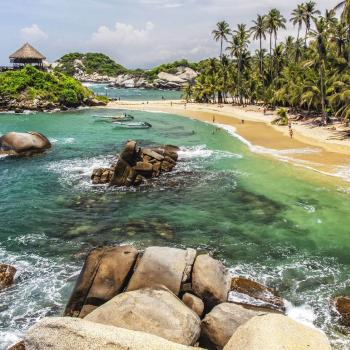
Just 42 kilometers away from the warm beaches of the Colombian Caribbean, there is a marvelous, icy landscape for ascending to perpetual snow. The two highest peaks of the Sierra Nevada de Santa Marta are Colón and Bolívar, at 5,775 meters above sea level, although some say the former is one meter taller than the latter.
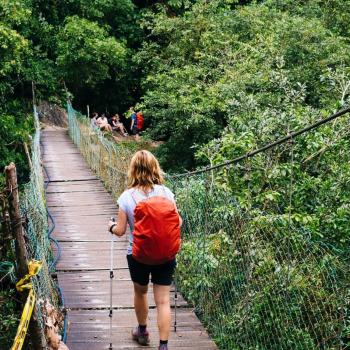
The adventure starts by car in the city of Valledupar and goes on to San Sebastián, an Arhuaco settlement. From there, a journey along paths and trails leads to lakes and glaciers located at 3,000 meters above sea level. When the mountain gets very steep, excellent mountain climbing equipment and experience are necessary for the ascent.
In the midst of the dense flora of the Sierra and its natural park, lies Ciudad Perdida, or Teyuna Archaeological Park, the birthplace of the Tayrona indigenous people, an advanced pre-Hispanic culture. A team of researchers discovered it in 1976, although a year before, a treasure hunter had found it. Its extension is roughly 13 hectares.
Ciudad Perdida – Lost City – amazes for the complexity of its architecture and canal system, and the terraces built for conserving soil fertility.
When the Tayrona indigenous people lived there, their settlements were connected by stone paths. They lived in window-less, thatched circular cabins erected on stone terraces.
What is surprising about Ciudad Perdida is the complexity of its architecture, which included a canal system to carry rain water to the villages and terraces and conserve the fertility of the soil. There are also rock paintings and petro-glyphs. The Donama rock stands out for the multiple interpretations given to its carvings.
The Sierra Nevada “is the umbilical cord that joins the origin and the present, the spiritual and the material, it is the union with the Mother”.
The Tayrona culture inhabited the Sierra Nevada prior to the Spanish Conquest. Following the conquest, its population of around one million inhabitants began to decrease to the point that it almost disappeared. At present, four indigenous communities that preserve their ancient traditions amount to about 30,000 people. They are the Kogis, Arhuacos, Wiwas, and Kankuamos.
For the indigenous people, “The Sierra Nevada is like a ceremonial house (…), it is the site where all the responsibility to the universe is concentrated, the place from which everything that is sacred and vital to the universe is watched over and guarded, it is the foundation and the union with the spiritual. “It is the umbilical cord that joins the origin and the present, the spiritual and the material, it is the union with the Mother.” Organización Gonawindúa Tayrona.
The Kogi community occupies the northern area of the Sierra, among the valleys of the Don Diego, Palomino, San Miguel, and Ancho rivers. Its members live in circular dwellings called “bohíos” and are under the authority of the Mamo, an elder that embodies ancestral wisdom and is the bridge between the spiritual and the terrestrial.
The meaning of “Wiwa” is “warm”, possibly reflecting the fact that they inhabit a lower region of the Sierra, where temperatures are quite high. Other meanings of the name are “give origin”, “propitiate”, and “engender”. And another way of calling them is by the name “Sanjá”, which means “native” or “Indigenous”. Their settlements are situated on the Sierra, in the department of Cesar, close to the border with the department of La Guajira.
Also known as “Ika” or “Ijka”, they live in the upper valleys of the Piedras, San Sebastián, Chichicua, Ariguaní, and Guatapurí rivers, south of the Sierra Nevada. The capital is Nabusimake and is located in the central area. They speak a language that belongs to the Chibcha family.
They are known as “Kankuaka”, “Kankui”, or “Kankuané”. Their traditions, language, and culture are undergoing a process of recovery, since most of their ancient memory was lost. The live on the eastern side of the Sierra Nevada, in the department of Cesar.
Another Sierra Nevada community is the Wayúu, originnaly from La Guajira and smaller in size than the four groups that descend from the Tayronas.
Kogi indigenous woman with artisan necklaces made from colored stones / Photo by Flickr user Sailing Nomad.
The wealth of the Sierra Nevada provides Indigenous people and artisans with the materials necessary for creating objects of great beauty. The tutus, or Tayona shoulder bags, stand out. The indigenous women weave them using wool, sisal, and cotton. The bags symbolize the creation of life.
The wealth of the Sierra Nevada provides indigenous people and artisans with the materials necessary for creating objects of great beauty.
Materials such as shell, coconut, seeds, tree bark, tagua (the so-called “vegetable ivory”, bone, and snail shell are several of the materials used for making necklaces, earrings, rings, watches, and bracelets. Other easily obtainable handicrafts are the sombrero vueltiao, the typical hat of the Colombian Caribbean region), sandals, key chains, and belts.
Additionally, they make decorative accessories such as ceramic pots, vessels, and plates and spoons from stone (especially piedra jabón), totumo (a relatively large gourd-like fruit with a shell that becomes very hard when dry), and clay.
© 2013 Proexport Colombia
This site uses Joomla as a platform, adaptation: Astrolabio.
Site validated with W3C standards